My name is Fahad Javed, and I hold a Bachelor’s degree in Business Administration (BBA) from the National University of Modern Languages (NUML).
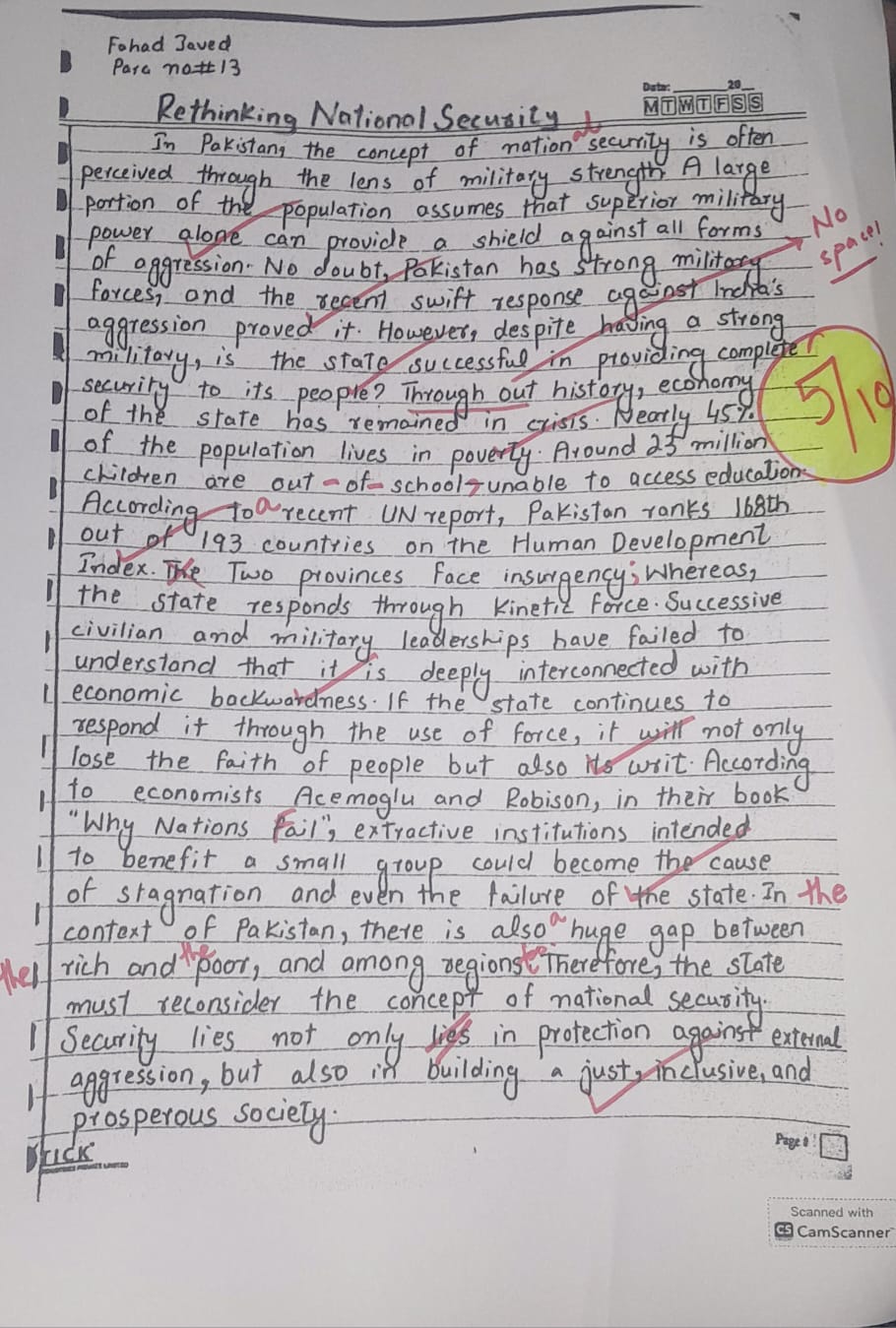
In Pakistan the concept of national security is often perceived through the lens of military strength. A large portion of the population assumes that superior military power alone can provide a shield against all forms of aggression. No doubt, Pakistan has strong military forces, and the recent swift response against India’s aggression proved it. However, despite having a strong military is the state successful in providing complete security to its people? Through out history, economy of the state has remained in crisis. Nearly 45% of the population lives in poverty. Around 23 million children are out-of-school, unable to access education. According to a recent UN report, Pakistan ranks 168th out of 193 countries on the Human Development Index. Two provinces face insurgency; whereas the state responds through kinetic force. Successive civilian and military leaderships have failed to understand that it is deeply interconnected with economic backwardness. If the state continues to respond it through the use of force, it will not only lose the faith of people but also its writ. According to economists Acemoglu and Robison, in their book “Why Nations fail”, extractive institutions intended to benefit a small group could become the cause of stagnation and even the failure of the state. In the context of Pakistan, there is also a huge gap between the rich and the poor, and among regions too. Therefore, the state must reconsider the concept of national security. Security lies not only lies in protection against external aggression, but also in building a just inclusive, and prosperous society.